
Mulholland, James
Mulholland, James
Before the Raj

- Year: 2005
- Publisher / Date: Johns Hopkins University Press, 2020
Anglo-India's regional literature was both a practical and imaginative response to a pivotal period in the early colonialism of South Asia.
During the later decades of the eighteenth century, a rapid influx of English-speaking Europeans arrived in India with an interest in expanding the creation and distribution of anglophone literature. At the same time, a series of military, political, and economic successes for the British in Asia created the first global crisis to shepherd in an international system of national ideologies. In this study of colonial literary production, James Mulholland proposes that the East India Company was a central actor in the institutionalization of anglophone literary culture in India. The EIC drew its employees from around the British Isles, bringing together people with a wide variety of ethnic and national origins. Its cultural infrastructure expanded from presses and newspapers to poetry collections, letters, paper-making and selling, circulating libraries, and amateur theaters.
Recovering this rich archive of documents and activities, Mulholland shows how regional reading and writing reflected the knotty geopolitical situation and the comingling of Anglo and Indian cultures at a moment when the subcontinent's colonial future was not yet clear. He shows why Anglo-Indian literary publics cohered during this period, reexamining the relationship between writing in English and imperial power in a way that moves beyond the easy correspondence of literature as an instrument of empire. Tracing regional and "translocal" links among Madras, Calcutta, Bombay, and settlements surrounding the Bay of Bengal, Before the Raj recovers a network of authors, reading publics, and corporate agents to demonstrate that anglophone literature adapted itself to geographical politics and social circumstances, rather than being simply imitative of the works produced in the English metropole.
Mulholland introduces readers to figures like the Calcutta-born Eyles Irwin, the first man to sustain a literary career from India. We also meet James Romney, an army officer who wrote poems and plays, including a stage adaptation of Tristram Shandy. Alongside these men were anonymous female poets, hailed as the harbingers of an "anglo-asiatic taste," and captive adolescent Europeans who, caught up in the conflict with southern India's last independent ruler, Tipu Sultan, were forcibly converted to Islam, castrated, and made to cross-dress as "dancing boys" for Tipu's entertainment. Revealing the vibrant literary culture that existed long before the characters of Rudyard Kipling's best-known works, Before the Raj reveals how these writers operated within a web of colonial cities and trading outposts that borrowed from one another and produced vital interlinked aesthetics.
James Mulholland is an assistant professor of English at North Carolina State University.
Sounding Imperial
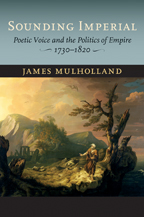
- Year: 2005
- Publisher / Date: Johns Hopkins University Press, 2013
In Sounding Imperial, James Mulholland offers a new assessment of the origins, evolution, and importance of poetic voice in the eighteenth and early nineteenth centuries. By examining a series of literary experiments in which authors imitated oral voices and impersonated foreign speakers, Mulholland uncovers an innovative global aesthetics of poetic voice that arose as authors invented new ways of crafting textual voices and appealing to readers. As poets drew on cultural forms from around Great Britain and across the globe, impersonating "primitive" speakers and reviving ancient oral performances (or fictionalizing them in verse), they invigorated English poetry.
Mulholland situates these experiments with oral voices and foreign speakers within the wider context of British nationalism at home and colonial expansion overseas. Sounding Imperial traces this global aesthetic by reading texts from canonical authors like Thomas Gray, James Macpherson, and Felicia Hemans together with lesser-known writers, like Welsh antiquarians, Anglo-Indian poets of colonialism, and impersonators of Pacific islanders. The frenetic borrowing, movement, and adaptation of verse of this time offers a powerful analytic by which scholars can understand anew poetry's role in the formation of national culture and the exercise of colonial power.
Sounding Imperial offers a more nuanced sense of poetry's unseen role in larger historical processes, emphasizing not just appropriation or collusion but the murky middle range in which most British authors operated during their colonial encounters and the voices that they used to make those cross-cultural encounters seem vivid and alive.
"Mulholland's superbly composed book reanimates eighteenth-century visions of poetic practices 'elsewhere' and details their shaping role in British poetics. His account of the remaking of oral or folk traditions within the conventions of poetry links poetic voice to the cultural exigencies of empire in remarkably inventive ways; this book will reenergize the study of eighteenth-century British poetry."—Suvir Kaul, University of Pennsylvania
"Discovering poetry that is 'barbaric, vast, and wild,' James Mulholland corrects the massive prose bias evident in postcolonial studies of the British Empire. Sounding Imperial compellingly explains how poetic archaism, lyrical inauthenticity, and ethnic impersonation inflect the strange and distant voices that reconsolidate the national via the bardic and the oriental."—Srinivas Aravamudan, author of Enlightenment Orientalism: Resisting the Rise of the Novel
"James Mulholland's Sounding Imperial is an impressive contribution, recovering in the eighteenth-century 'fantasy of unmediated voices' a tradition of experimental poetry. Mulholland persuasively articulates an emergent global poetics; his meditations on print, the performed voice, impersonation, and transnational poetics help to redraw the cultural map. Incisive and elegant."—Maureen N. McLane, New York University
"This is an excellent book, and one that will appeal not just to lovers of poetry but to historians of the Empire and sociologists who study trans-national influences."—Clifford Cunningham, Sun News Miami
James Mulholland is an assistant professor of English at North Carolina State University.